The Announcement That Made Everyone Sit Up
Last November at re:Invent, AWS showed off two things that immediately caught the attention of anyone serious about cloud economics: Graviton4 processors and Amazon Nova models. The messaging was straightforward. Graviton4 promised 30 percent better performance per dollar than its predecessor for memory-heavy workloads. Nova Micro, the smallest model in the family, came in at $0.000035 per input token, undercutting comparable alternatives by 60 to 75 percent. On paper, these numbers looked compelling. The question that mattered was whether they held up in the real world, where abstractions collide with architecture decisions, licensing constraints, and the messy business of actually migrating workloads.
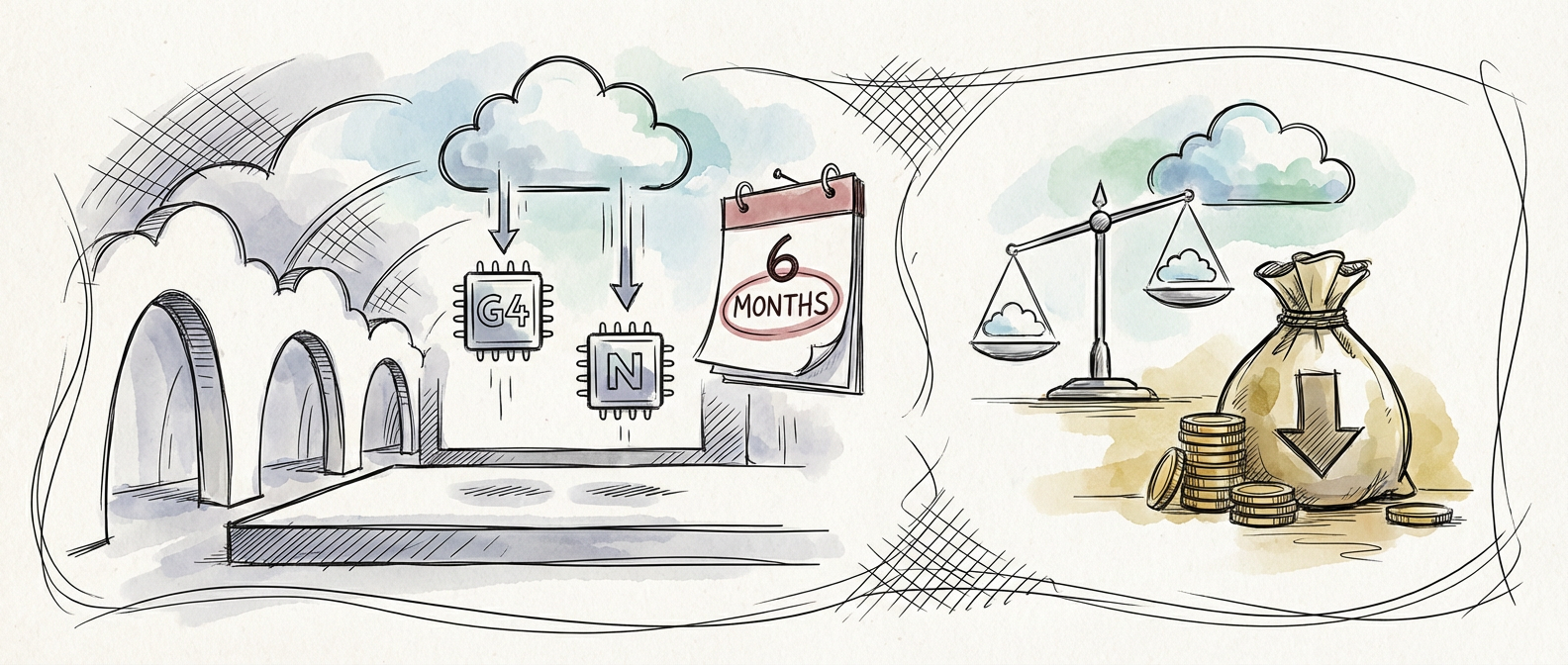
Six months in, we have enough data to move past the announcement cycle and into something more useful: honest assessment. I have spent considerable time examining what these technologies actually deliver in production environments, not just what they promise in marketing materials. The story is more complicated than either the enthusiasts or the skeptics would have you believe.

Understanding What Changed Under the Hood
To make sense of whether these cost improvements are real, you need to understand what AWS actually built. Graviton4 moved to a 4 nanometer process and jumped from 64 cores in Graviton3 to 96 cores running Arm Neoverse V2 architecture. That is not a minor bump. The increase in core count alone matters, but so does the efficiency gain from the smaller process node. More compute density without proportionally higher power consumption translates directly to your bill.
For database workloads and containerized applications, this architectural jump means something concrete: better instruction execution, improved memory handling, and lower latency in specific operations. The R8g instance family, which pairs Graviton4 with memory optimization, is the logical evolution for workloads where memory bandwidth and latency have always been the constraint. If you have ever found yourself limited by how quickly your application can move data between the CPU and RAM, Graviton4 addresses precisely that friction point.
Amazon Nova tells a different story. These are smaller, purpose-built foundation models that AWS tuned specifically for cost-conscious deployments. Micro, the entry-level option, handles straightforward language tasks without requiring the computational overhead of larger models. The pricing reflects that specialization. What matters for most teams is not that Nova is a breakthrough in model capability, but that it removes a barrier: you can now afford to deploy a foundation model for tasks where the previous economics simply did not work.
Early Data From Teams Actually Running This Stuff
Companies like Datadog and Snap published their migration results in Q1 2025, and the numbers deserve attention because they come from teams running production systems at serious scale. Datadog moved containerized workloads to C8g instances and reported 20 to 28 percent cost reductions in compute. Snap saw similar improvements with R8g for memory-intensive operations. These are not synthetic benchmarks in a lab. These are cost reductions from teams that did the work of actually migrating, validating compatibility, and measuring the difference.
What makes these case studies credible is how modest the claims are. Twenty to 28 percent is meaningful but not magical. It tells you that AWS is not exaggerating the architectural improvements. The efficiency gains are real, but they are bounded by what physics and silicon design can actually deliver. There are no 10x improvements hiding here. What you get is solid, predictable, double-digit cost reduction for workloads that fit the architecture.
The Flexera 2025 State of the Cloud Report found that 59 percent of enterprises ranked cost optimization as their top cloud initiative. That context matters. Graviton4 landed at exactly the moment when organizations most needed it. Procurement teams were asking hard questions about cloud spending. These new options gave infrastructure teams a concrete answer: migrate these workloads to Graviton4, reduce costs, and see measurable results.
Where This Actually Works, and Where It Does Not
The crucial detail that most marketing conveniently glosses over is that not every workload benefits equally. Graviton4 excels with containerized applications, relational databases, caching layers, and anything built on open-source software stacks. If your team uses Docker, Kubernetes, PostgreSQL, Redis, or similar tooling, migration is straightforward and the cost savings materialize. Check the AWS Graviton4 instance family documentation and you will see the compatibility list. It is impressive.
But here is where the story gets complicated. If your workloads depend on proprietary software with x86 licensing, or if you run legacy applications that never made the jump to containerization, Graviton4 is not a solution. Recompiling your entire codebase or reworking a monolithic application architecture just to chase a 20 percent cost reduction is not a reasonable trade-off. Graviton4 is for teams whose stacks are already cloud-native or well on the way there. That boundary is worth being clear about before you sell the migration internally.
Nova Micro tells a similar story. It is exceptional for summarization, classification, Q and A, and other well-defined tasks. If you need complex reasoning or multi-turn conversations with real back-and-forth, the larger models still make more sense. The cost advantage of Micro dissolves quickly if you end up making compensatory API calls because the smaller model could not handle your specific use case.
What I Would Actually Build With This Today
If you are starting a new project and wondering whether to build on Graviton4 or Nova, my answer is yes, but be intentional about which problems you are solving. Start with Nova Micro for any task where you need a language model and the task is well-defined. Run the real numbers on your specific workload. You might find that the 60 to 75 percent cost reduction makes it viable to integrate AI capabilities that previously seemed too expensive to justify. That is a genuine unlock for many teams.
For infrastructure, start with your most stable, well-tested containerized workloads. These are the low-risk candidates for Graviton4 migration. Run them in parallel with your existing x86 instances for a few weeks. Measure actual performance and cost. Once you have confidence, scale up to other workloads in the same family. This is not a panic migration. It is methodical, data-driven, and lets you move at the pace your organization can actually support.
The broader lesson six months later is that AWS delivered on the core promise: real, measurable cost improvements for teams in the right architectural position to use them. The improvements are meaningful but not revolutionary. They are the kind of gains that, when multiplied across hundreds or thousands of instances over time, become significant budget items. That is exactly what most organizations need right now. Check the Flexera 2025 State of the Cloud Report and you will see cost optimization remains the dominant priority. These technologies are practical tools for addressing that priority, not magic bullets.
If you have experiences deploying either Graviton4 or Nova in your own environment, I would be interested in hearing what actually worked, what did not, and where the real-world numbers surprised you. The architecture decisions you make with these technologies matter, and the learning curve is most useful when we share it.